If you’ve ever worked in bulk material handling, you’ve probably relied on components that keep processes running smoothly without you noticing them day-to-day. For 12 years, I’ve been a rotary airlock valve supplier, and one question that still comes up—even from experienced plant managers—is: “What exactly is a threaded rotary airlock valve, and why does it matter more than a welded or flanged model for my operation?” It’s not just a piece of equipment; it’s the gatekeeper between two pressurized systems, the seal that keeps dust out and product in, and the part that can shut down your entire line if it’s not the right fit. Let me break this down like I do with every customer who calls in confused about which valve to order. Rotary Airlock Valve
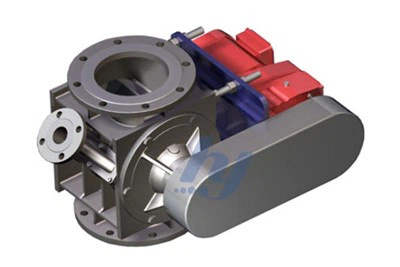
First, let’s start with the basics. A rotary airlock valve, also called a rotary feeder, is a device that transfers bulk solids—like flour, plastic pellets, wood chips, or even powdered chemicals—from one part of a processing system to another while maintaining an airtight (or pressure-tight) seal. Think of it as a rotating drum with evenly spaced pockets; as the drum turns, pockets pick up material from the inlet, carry it around, and drop it out the outlet. The critical job here is that the space between the drum’s tips and the valve housing is tiny—usually thousandths of an inch—so air can’t rush through the gaps as material moves. That’s what keeps pressure consistent on both sides, which is non-negotiable for everything from pneumatic conveying systems to dust collection units.
Now, the threaded part. Not all rotary airlock valves attach to piping the same way. Flanged valves, for example, have bolted plates on the ends that line up with matching flanges on your process pipes. Welded valves get permanently fused to the piping, which is great for heavy-duty, high-pressure jobs but a nightmare if you ever need to replace or move the valve later. Threaded valves, though, have external threads cut directly into the valve’s inlet and outlet ports, so you can screw them directly into standard NPT (National Pipe Thread) pipes or adapters. That sounds simple, but it’s a game-changer for smaller-scale operations or spaces where access is tight.
Let’s get into when a threaded rotary airlock valve makes sense—and when it doesn’t, because I don’t sell every valve to every customer. Threaded models are almost always designed for low-pressure, low-flow applications. Most of our threaded valves handle system pressures between -10 PSI (vacuum) and +15 PSI, which is perfect for things like small dust collectors, batch mixing lines, lab-scale material testing, or food processing setups where pressure is mild and space is limited. If your operation is moving 500 pounds of plastic pellets per hour through a 10-inch pipe, a flanged valve is going to be more reliable, but if you’re moving 50 pounds of fine flour per hour through a 2-inch pipe in a commercial bakery, a threaded valve will fit right in without taking extra room.
One common misconception I hear: “A threaded valve must be less durable than a flanged one.” That’s not true, at least not from a reputable supplier. The key difference isn’t the attachment method—it’s the material and tolerance. Our threaded valves are made from 304 stainless steel for food-grade or corrosive materials, carbon steel for wood or heavy pellets, and even aluminum for lightweight plastics. The machining on the rotor and housing is identical to our flanged models: we hold tip clearances to 0.005 inches, use precision-machined rotors with balanced pockets to prevent wobbling, and add seals (like graphite or nitrile) between the housing end plates and rotor shaft to keep air leaks to less than 1 CFM. Where the durability comes in is installation: threaded valves don’t require welding or heavy flange bolts, so you can mount and remove them in 10 minutes with just a pipe wrench, which cuts down on maintenance time and reduces the risk of damaging your piping during replacement.
Wait, let’s talk about the installation side, because that’s where most customers run into issues. A lot of first-time buyers try to force a threaded rotary airlock valve into a pipe that’s not properly prepared, and that’s when leaks happen. You can’t just twist the valve into a pipe without wrapping the threads with Teflon tape or using pipe thread sealant to make the airtight seal work. I always tell customers: if you can see gaps between the valve’s threads and the pipe, you’re going to lose pressure, which means your pneumatic conveyor will slow down, or your dust collector won’t pull enough air, leading to messy, unsafe dust buildup. For that reason, threaded valves aren’t recommended for high-vibration environments, either—constant vibration can loosen the threads over time, so we usually suggest welded or flanged models for sawmills or mining operations where equipment shakes nonstop.
Another big use case for threaded rotary airlock valves: food and pharmaceutical processing. The FDA requires equipment that touches food or drug materials to be easy to clean and non-porous. Threaded valves are easier to disassemble for cleaning than welded models—you just unscrew them from the piping, take off the end plates, and wipe or pressure-wash the interior. Flanged models require removing multiple bolts, which can leave gaps where bacteria or product residue gets trapped. That’s why most small to medium food manufacturers (like bakeries, cereal plants, and spice grinders) in my customer base swear by threaded valves for their transfer lines.
Let me give you a real example to make this concrete. Last year, a small craft brewery called me because their existing rotary airlock was leaking, leading to lost grain during their malt transfer process. They had a flanged valve that had been installed wrong by a third-party contractor—flanges were misaligned, so there was a ¼-inch gap between the valve and the pipe, causing them to lose 10-15 pounds of grain per batch. They didn’t have the budget to replace the entire pipe section with a new flange setup, so we recommended a 2-inch threaded rotary airlock valve. It screwed directly into their existing pipe, we showed them how to apply Teflon tape correctly, and they’ve used it for 18 months without a single leak. They told me it cut their grain loss by 90% and saved them over $2,000 in the first six months alone. That’s the kind of practical value I love to see from a threaded valve.
Now, let’s talk about the drawbacks, because I’d be doing my customers a disservice if I didn’t mention them. Threaded rotary airlock valves have smaller port sizes than most flanged models—typically 1.5 to 4 inches, though we can make custom sizes up to 6 inches for specialized jobs. That means they’re only good for lower volume applications; if you need to move more than 1,000 pounds of material per hour, a larger flanged valve is a better choice. Also, their pressure rating is lower: as I mentioned earlier, most top-quality threaded valves max out around +15 PSI, so if your system runs at higher pressure, you’re going to need a flanged or tri-clamp valve. Tri-clamp is another attachment style, but that’s a separate conversation—just know that threaded is not for high-pressure, high-volume industrial lines.
For anyone who’s still on the fence, here’s a quick checklist to figure out if a threaded rotary airlock valve is right for you:
- Are you moving bulk solids (not liquids, by the way—these are strictly for dry, free-flowing or semi-free-flowing solids)?
- Is your piping size between 1.5 and 6 inches?
- Is your system pressure less than +15 PSI or more vacuum than -10 PSI?
- Do you need easy access for cleaning, maintenance, or replacement?
- Do you have limited space around your process line?
If you answered “yes” to most of these, a threaded valve is almost certainly the best option for you.

I’ve been in this business long enough to know that a lot of suppliers will push you into whatever valve they have in stock, but I take the time to ask customers about their specific setup instead. A threaded rotary airlock valve that’s installed correctly will outlast a cheaper flanged valve that’s mismatched for your operation. That’s why we test every threaded valve before it leaves our shop: we run air leak tests at 5 PSI, check rotor balance, and inspect thread seals to make sure no leaks will slip through. We also offer replacement parts for all our threaded models, so if a rotor tip wears down after a few years, you don’t have to buy an entirely new valve—just swap out the rotor.
De-Dust Collector At the end of the day, a threaded rotary airlock valve is a simple, underrated piece of equipment, but it’s the difference between a smooth-running process and a headache of leaks, lost material, and downtime. If you’re not sure whether you need one, or if you’re dealing with a valve that’s underperforming, I’m here to help. Reach out to discuss your specific application, and I’ll walk you through sizing, materials, and installation tips to make sure you get the right valve for your operation.
References
- ASTM International. (2020). Standard Specification for Rotary Airlock Valves for Bulk Material Handling. ASTM D6988-20.
- Material Handling Industry Association. (2021). Guide to Selecting Rotary Feeders for Pneumatic Conveying Systems. MHI Technical Report #007.
- FDA. (2022). Food Equipment Manufacturing Guidelines for Rotary Valves. FDA Chapter 4: Equipment Design and Construction.
- National Pipe Thread Manufacturers Association. (2019). Standard for Threaded End Connections for Process Valves. NPTMA RP-1.
Shanghai Hanye Engineering Technology Co., Ltd.
As one of the most experienced rotary airlock valve manufacturers and suppliers in China, we offer a wide range of products with superior quality. We warmly welcome you to buy customized rotary airlock valve at competitive price from our factory. For more information, contact us now.
Address: Building 7, No.428 Banqiao East Road, Shanyang Town, Jinshan District, Shanghai
E-mail: Windy@hanye-tech.com
WebSite: https://www.hanyeconveying.com/
